Urge Timer
When a craving hits, give it fifteen minutes.
A craving feels permanent while it's happening. That feeling is the least reliable part of it.
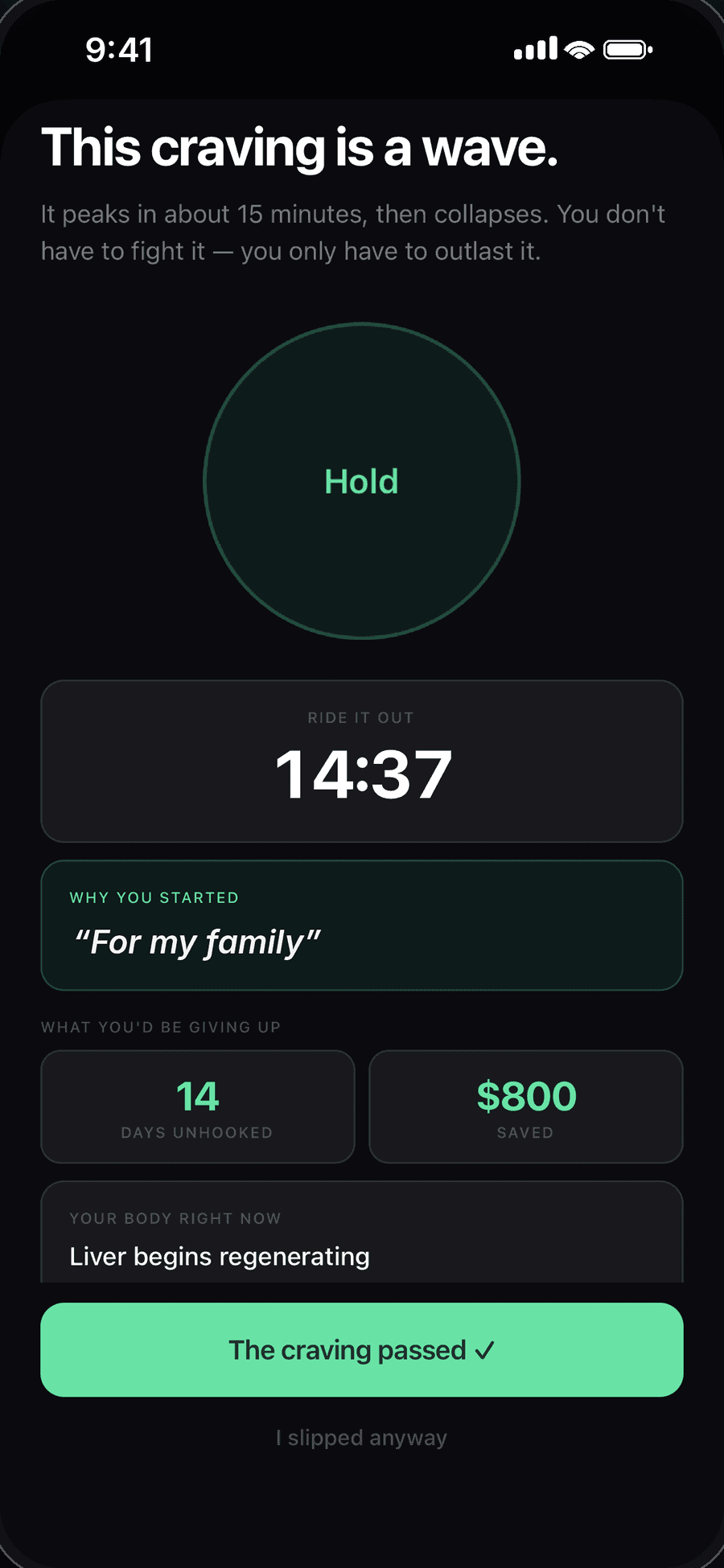
The Unhooked Urge Timer is a craving tool for the exact moment temptation lands: a 15-minute countdown, a breathing circle to slow you down, the reason you wrote on day one, and everything you'd be giving up — on a single screen, one tap from anywhere in the app.
How an urge behaves
It rises, it peaks, and then it goes.
An urge isn't a steady state you have to endure indefinitely. It behaves much more like a wave: it builds, reaches a peak, and subsides — commonly described as passing within roughly fifteen to twenty minutes if you don't feed it.
The trouble is that at the peak it feels like the opposite. It feels like pressure that will keep climbing until you give in, which is precisely the belief that makes people give in. Acting on it also teaches the pattern that the urge works, which is why the next one arrives with more confidence.
Waiting it out does the reverse. Each urge you let pass without acting is evidence — to you and to the habit — that the prediction doesn't pay off.
This idea isn't new: riding out an urge rather than fighting it is a standard technique in behavioural approaches to addiction, usually called urge surfing. The Urge Timer is that technique with a countdown attached.
Why a timer
"Don't think about it" is not a strategy.
Trying to suppress a thought tends to keep it in the room. Telling yourself not to think about the thing you're craving generally means checking, repeatedly, whether you're still thinking about it — which is thinking about it.
A timer changes the task. Instead of an open-ended instruction to resist forever, you get a small, finite, obviously achievable job: be here when this hits zero. The goal stops being "never again" and becomes "not in the next fifteen minutes", which is a fight you can actually win.
It also removes the negotiation. Mid-craving, your own reasoning is working for the other side. A countdown doesn't argue back and doesn't get tired.
What's on the screen
Fifteen minutes, structured.
- 1
A countdown
Visible, running, and asking nothing of you except that you don't act until it's done.
- 2
A breathing circle
Something to do with your attention and your body while the wave passes, instead of watching the seconds.
- 3
Your own reason
The sentence you wrote when you were thinking clearly, shown back to you when you aren't.
- 4
What's at stake
Your current streak and what you'd be giving up, so the trade is explicit rather than abstract.
- 5
A way out that isn't relapse
The coach is one tap away if fifteen minutes of silence isn't what you need tonight.
Questions about cravings
How long do cravings last?
Individual urges are usually short — commonly described as peaking and passing within about fifteen to twenty minutes when you don't act on them. What lasts longer is the tendency for urges to keep arriving, which typically becomes less frequent and less intense over weeks and months rather than days.
What if the craving comes back afterwards?
It probably will, and that's expected rather than a sign of failure. Start the timer again. Each wave you don't act on tends to be a little less convincing than the one before.
What if fifteen minutes isn't enough?
Run it again, or open the coach and talk it through instead. Some nights need conversation more than a countdown, which is why both are one tap from the same screen.
Is this the same as urge surfing?
It's the same underlying idea — observing the urge and letting it crest rather than fighting or obeying it — with a timer, your reason and your streak attached, so you don't have to hold the technique in your head while you're using it.
What should I do when I feel like relapsing?
Change your physical situation, start the timer before you start negotiating, and tell someone — the coach counts. The order matters: acting first and thinking second is what keeps the decision out of the hands of the part of you that's currently craving.
Your quit date starts the day you decide.
Download Unhooked and get full access free for your first day. No payment details, nothing to cancel.